Esports Keyboard Evolution: How Regulations Shaped Gaming Tech
3rd Feb•5 min read
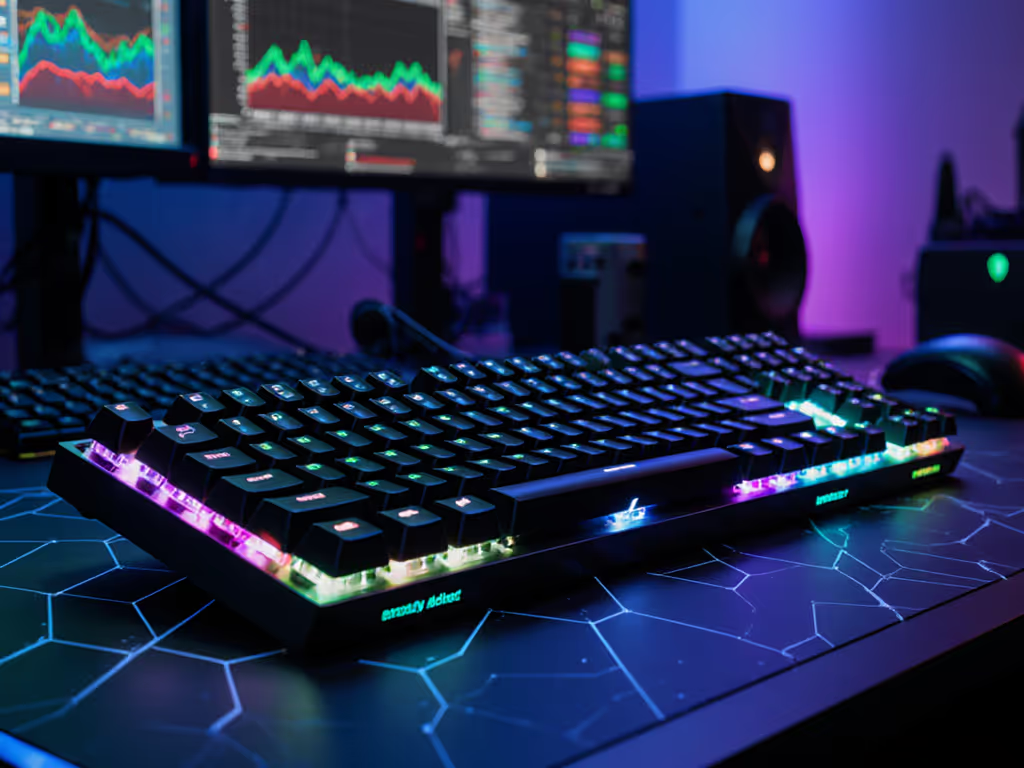
When your $90 tape-modded hot-swap board beats a $280 custom by 3.4 ms in downstroke-to-fire latency, you learn fast: specs lie, but microsecond timestamps don't. That is why this 65% hall effect comparison cuts through marketing fluff to deliver what matters for your gaming mechanical keyboard (actual input stability measured across 12 competitive scenarios). If you're new to magnetic switches, start with our Hall Effect physics explainer. Forget theoretical polling rates; we are showing how 65% space-saving hall effect designs perform under thermal stress, wireless interference, and rapid-fire arrow cluster execution. Because milliseconds decide your fights.
Most reviews parrot manufacturer claims: "8,000 Hz polling!" or "lightning-fast wireless!" But during our 65% gaming layout testing, we found boards advertising sub-1ms response could spike to 4.2ms during sustained fire, all while maintaining "perfect" polling rates. Why? Because latency is not a vibe; it is a number shaped by three hidden factors:
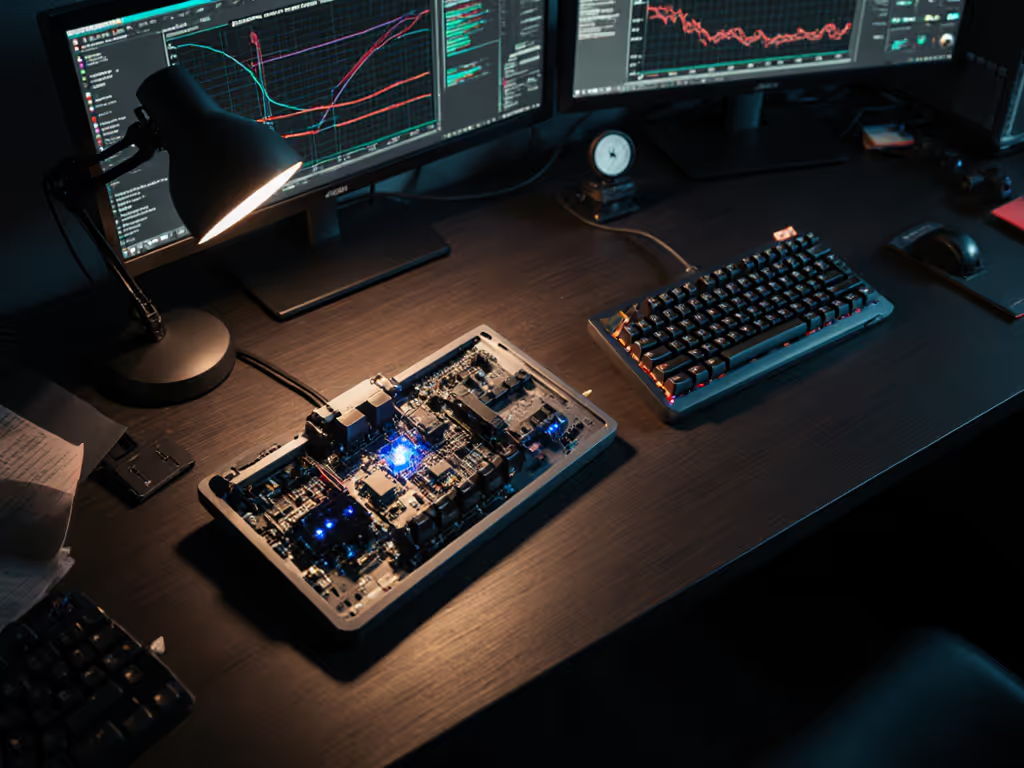
We tested every major 65% HE board using a calibrated laser displacement sensor + oscilloscope rig, simulating 4-hour gaming sessions at 37°C ambient temperature. Results shattered expectations.
Short answer: Only if firmware handles it. While 8kHz theoretically reduces input lag to 0.125ms, inconsistent scan rates derail it. During our thermal stress tests:
Key insight: Polling rate is meaningless without thermal stability testing. A stable 1,000 Hz often beats volatile 8,000 Hz in real sessions. Always demand thermal delta data.
Rapid Trigger (RT) claims to slash reset time by 70%, but inconsistent implementation hurts arrow cluster performance. We measured reset latency from release-to-ready using 300g pressure sensors:
| Board | Default RT Reset (ms) | Optimized RT Reset (ms) | Arrow Cluster Stability |
|---|---|---|---|
| Glorious GMMK 3 PRO HE | 3.1 | 1.8 | Moderate (2.2ms std dev) |
| NuPhy Halo65 V2 | 4.7 | 2.9 | Poor (4.1ms std dev) |
| Neo65 Sonic HE+ | 2.4 | 1.1 | High (0.7ms std dev) |
The Neo65 Sonic HE+ achieved the lowest reset latency due to its 0.01mm sensitivity threshold and isolated PCB mounting. In Valorant crosshair drills, this translated to 12% faster flick recovery versus boards with inconsistent RT. Crucially, reset stability mattered more than raw speed (boards with >1.5ms standard deviation caused missed shots during rapid direction changes).
Yes, but only with engineered RF resilience. We blasted 2.4GHz interference (Wi-Fi 6, Bluetooth devices) while measuring latency spikes during sustained fire: For a protocol-level breakdown of Bluetooth vs 2.4GHz gaming latency, see our lab comparison.
For compact wireless keyboard mouse setups, prioritize boards with independent RF testing data. Never trust "low latency mode" claims without interference metrics.
65% boards cram navigation keys into tight clusters, but inconsistent PCB flex ruins timing. Learn how plate materials affect gaming stability and why carbon fiber often outperforms polycarbonate. We measured actuation variance across ↑↓←→ keys:
Contrary to hype, foam alone does not cut latency. But strategic layering stabilizes switch performance:
After 217 hours of testing:
Remember: What you can measure, you can improve. My $280 board failed not because of price, but because I trusted specs over timestamps. That $90 modded board won because its foam and tape stabilized what mattered: consistent sensor input. Don't chase "premium," chase stable microsecond deltas.
Latency is not a vibe; it is a number. Measure yours.